
Compliance · Wet vs e-sign
Wet Signature vs Electronic Signature: When EU Law Still Requires Ink (and When It Doesn't)
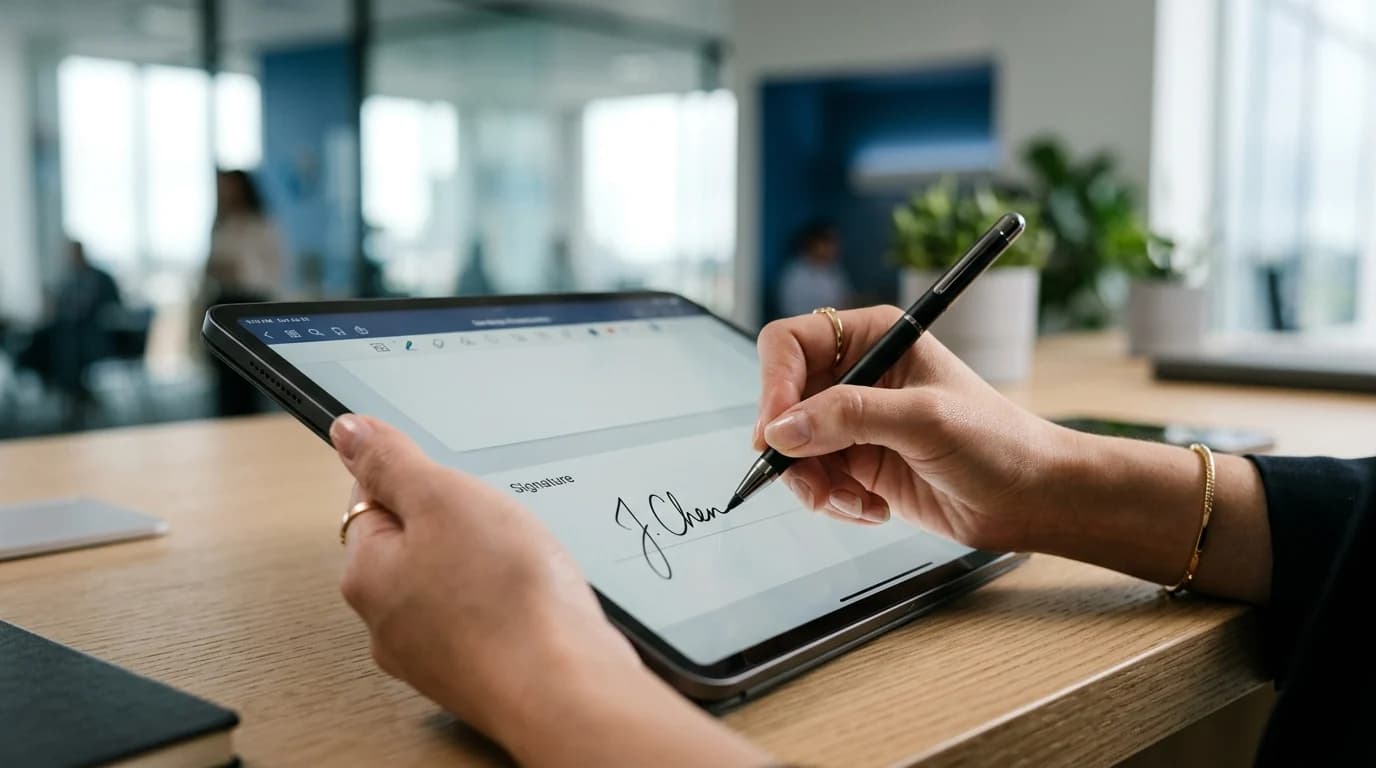
Most teams assume that a contract only counts if someone prints it, signs it in ink, and scans it back. Under EU law that assumption is wrong far more often than it is right. The eIDAS Regulation has made the electronic signature the default for the overwhelming majority of business agreements, from supplier contracts and NDAs to employment offers and statements of work. The real question is rarely *can* you sign electronically — it is *which level* of electronic signature the document deserves, and whether it falls into one of the genuinely narrow exceptions where a wet signature or a notary is still mandatory.
This guide untangles the wet signature vs electronic signature question for organisations operating in the Baltics and the wider EU. We will define each term precisely, explain the eIDAS default and why it holds for almost every commercial contract, walk through the exceptions that still demand ink or notarisation, look at how individual member states draw the line differently, and finish with a practical decision rule you can apply per document. This is general information to help you ask better questions, not legal advice — for any specific document or jurisdiction, confirm the position with a qualified lawyer.
Wet, electronic, and digital signatures: what each term actually means
A wet signature is the original sense of the word: a person physically marking a document with pen and ink, on paper. Its legal weight comes from the physical artefact and, where disputed, from handwriting analysis and the chain of custody of the paper itself. For centuries it was the only option, which is why so many people still treat it as the gold standard. In reality it is simply the oldest method of expressing intent to be bound — and one of the harder methods to verify reliably at scale.
An electronic signature is defined broadly by eIDAS (Regulation (EU) No 910/2014) as data in electronic form attached to or logically associated with other data, used by the signatory to sign. That definition is deliberately wide: a typed name, a clicked "I agree" button, a scanned signature image and a cryptographically bound national-eID signature can all be electronic signatures. What distinguishes them is the assurance level, which eIDAS splits into three tiers — Simple (SES), Advanced (AES) and Qualified (QES) — each carrying progressively stronger guarantees about *who* signed and whether the document changed afterwards.
"Digital signature" is a related but narrower technical term that is often used loosely. Strictly, it refers to the public-key cryptography that underpins the higher assurance levels — the maths that binds a signer's identity to a document and detects tampering. So a QES is built on a digital signature, but not every digital signature reaches qualified status. The practical takeaway: stop thinking in terms of *electronic vs handwritten* and start thinking in terms of *how much identity assurance and tamper-evidence this particular document needs*.
The eIDAS default: why an electronic signature is enough for almost every business contract
The foundational principle of eIDAS is non-discrimination: an electronic signature cannot be denied legal effect or admissibility as evidence in court *solely* because it is electronic or because it does not reach the qualified level. In other words, a clicked SES on a commercial agreement is not automatically worthless — courts must consider it on its merits. This reflects the older European tradition of freedom of form: most contracts are valid however the parties choose to express agreement, including verbally, so a competent electronic signature is comfortably sufficient.
The strongest guarantee sits at the top tier. Under Article 25 of eIDAS, a Qualified Electronic Signature (QES) has the legal effect equivalent to a handwritten signature across every EU member state, and a QES based on a qualified certificate in one member state must be recognised in all the others. That is the legal bridge that lets a QES stand in for ink even where a statute appears to expect a signature. For everyday business, you rarely need to climb that high — but it is reassuring to know the ceiling exists and is harmonised EU-wide.
For the vast bulk of commercial paperwork — supplier and reseller contracts, NDAs, employment offers, order forms, statements of work, consent forms — an electronic signature, typically an AES bound to a verified identity, is more than adequate and usually produces *better* evidence than a scanned wet signature. This is exactly the lane DokDesk is built for: reusable templates, negotiation on a single live version, and eIDAS e-signing with national eIDs such as Smart-ID and Mobile-ID, all feeding a court-ready evidence base. None of this removes the need to check whether your specific document is one of the rare exceptions — which is where a lawyer earns their fee.
The exceptions list: documents that still require ink or notarisation across the EU
eIDAS sets the framework for *recognition* of electronic signatures, but it deliberately leaves form requirements — whether a particular document must be written, notarised, witnessed or signed by hand — to national law. So the exceptions are not found in eIDAS itself; they live in the civil codes and sector statutes of each member state. The reliable pattern is that high-stakes, irreversible or third-party-affecting transactions are the ones most likely to demand more than a plain electronic signature.
The categories that most commonly still require a wet signature, notarisation or a specific qualified form include: real-estate transfers and the registration of property; the creation of wills, inheritance and succession documents; certain family-law acts such as marriage and some prenuptial arrangements; some company-formation and corporate-register filings; and particular guarantees, sureties or powers of attorney that grant significant authority over assets. In several of these, the requirement is not merely "on paper" but "executed before a notary", which an ordinary e-signature — even a QES — cannot satisfy on its own.
A second, subtler category is documents where a statute specifically prescribes the qualified level. Here the document *can* be signed electronically, but only a QES will do; an SES or AES will not meet the legal form. Because these lists vary by country and change over time, the safe operating rule is: treat property, inheritance, family-law, notarial and certain corporate acts as presumptively *outside* ordinary e-signing until confirmed otherwise. This is general guidance, not legal advice — always verify the exact requirement for your document type in the relevant jurisdiction with a qualified lawyer before relying on any signature method.
National variation: how the Baltics and other member states draw the line differently
Because form requirements are national, two member states can treat the *same* document type differently. The Baltic states sit at the digital-forward end of the spectrum: Estonia, Latvia and Lithuania have deeply embedded national eID infrastructure, and tools like Smart-ID and Mobile-ID are used routinely by citizens and businesses for legally significant signing. In practice this means a far higher share of everyday transactions are completed electronically than in many other parts of the EU, with strong assurance built in by default.
Other member states are more conservative, often retaining notary involvement for transactions that the Baltics handle digitally, or requiring specific written form where a Baltic counterpart accepts an electronic equivalent. None of this breaks cross-border recognition: a QES valid in one member state remains valid in all of them under Article 25, so a properly qualified signature travels across borders. What does *not* travel automatically is the underlying *form requirement* — a document that must be notarised in country A is not rescued by being e-signed under country B's more permissive rules.
The horizon is eIDAS 2.0 — Regulation (EU) 2024/1183 — and the EU Digital Identity Wallet, which aim to give every EU resident a portable, interoperable digital identity for both public and private services. That should make high-assurance signing more uniform and accessible across borders over time, narrowing today's friction. For now, the practical reality stands: confirm the form requirement in the specific country governing your contract, and do not assume the Baltic, German or French answer is identical. When the stakes are real, take qualified local legal advice.
A practical decision rule: choosing ink, SES, AES, or QES per document type
Start by asking one question for every document: what happens if the signature is challenged? The higher the value, the harder it is to reverse, and the more it affects third parties, the more identity assurance and tamper-evidence you want. Map that to the tiers. A Simple Electronic Signature (SES) — a click-to-agree or typed name — suits low-risk, high-volume items: internal approvals, routine consents, terms acceptance. It is fast and valid by default under eIDAS, but it carries the lightest evidentiary weight if disputed.
An Advanced Electronic Signature (AES) is the workhorse for real business contracts. Under Article 26, an AES must meet four requirements: it is uniquely linked to the signatory, capable of identifying the signatory, created using signature-creation data the signatory can use under their sole control, and linked to the signed data so any later change is detectable. Bound to a verified national eID such as Smart-ID or Mobile-ID, an AES gives you strong, court-ready evidence of who signed and that the document is intact — which is why it is the right default for supplier deals, NDAs, employment and SOWs. A Qualified Electronic Signature (QES) adds a qualified certificate and a qualified signature-creation device, earning the Article 25 handwritten-equivalent status; reserve it for documents that statute specifically requires at the qualified level. And keep ink or notarisation for the genuine exceptions — property, wills, certain corporate and family-law acts — identified above.
DokDesk supports SES and AES signing with national eIDs, and is architecture-ready for QES, with all data kept in the EU under GDPR and a court-ready evidence base behind every signature. Two honest caveats: DokDesk does not itself issue qualified signatures and is not a qualified trust service provider, so a true QES is sourced through a qualified provider; and DokDesk is not a law firm. Treat this decision rule as a starting framework, not a legal opinion — for any document where you are unsure of the required form, confirm the answer with a qualified lawyer in the relevant jurisdiction before you sign.
Frequently asked questions
- Is an electronic signature legally binding in the EU?
- Yes, in almost all cases. Under eIDAS (Regulation (EU) No 910/2014) an electronic signature cannot be denied legal effect or refused as court evidence solely because it is electronic. For the strongest position, a Qualified Electronic Signature (QES) carries handwritten-signature equivalence EU-wide under Article 25. The main exceptions are specific document types — such as property, wills and certain notarial acts — where national law still requires a particular form. This is general information, not legal advice; confirm your document type with a qualified lawyer.
- What is the difference between SES, AES and QES?
- They are the three eIDAS assurance levels. A Simple Electronic Signature (SES) is the broad baseline, such as a click-to-agree, with the lightest evidentiary weight. An Advanced Electronic Signature (AES) meets the four Article 26 requirements — uniquely linked to the signatory, able to identify them, under their sole control, and tamper-evident — making it the practical default for business contracts. A Qualified Electronic Signature (QES) adds a qualified certificate and device and, under Article 25, has the legal effect of a handwritten signature across the EU.
- When do I still need a wet signature or a notary in the EU?
- When national law prescribes a specific form. The categories most commonly affected are real-estate transfers and property registration, wills and succession documents, some family-law acts, certain company-formation filings, and particular guarantees or powers of attorney — many of which require execution before a notary. eIDAS leaves these form requirements to each member state, so they vary by country. Treat these document types as presumptively outside ordinary e-signing until confirmed with a qualified lawyer in the relevant jurisdiction.
- Are Smart-ID and Mobile-ID signatures valid across the EU?
- National eIDs such as Smart-ID and Mobile-ID are widely used across the Baltics to create strong electronic signatures, typically at the Advanced level, which provide robust, court-ready evidence of who signed and that the document is intact. Cross-border recognition is strongest at the qualified level: a QES valid in one member state is recognised in all others under Article 25. For any cross-border transaction, verify both the assurance level required and the form requirement in the governing jurisdiction.
- Can DokDesk issue a Qualified Electronic Signature (QES)?
- No. DokDesk supports SES and AES signing with national eIDs such as Smart-ID and Mobile-ID, with data kept in the EU under GDPR and a court-ready evidence base, and it is architecture-ready for QES. However, DokDesk does not itself issue qualified signatures and is not a qualified trust service provider, so a true QES is obtained through a qualified provider. DokDesk is also not a law firm; for the required signature level on a specific document, consult a qualified lawyer.